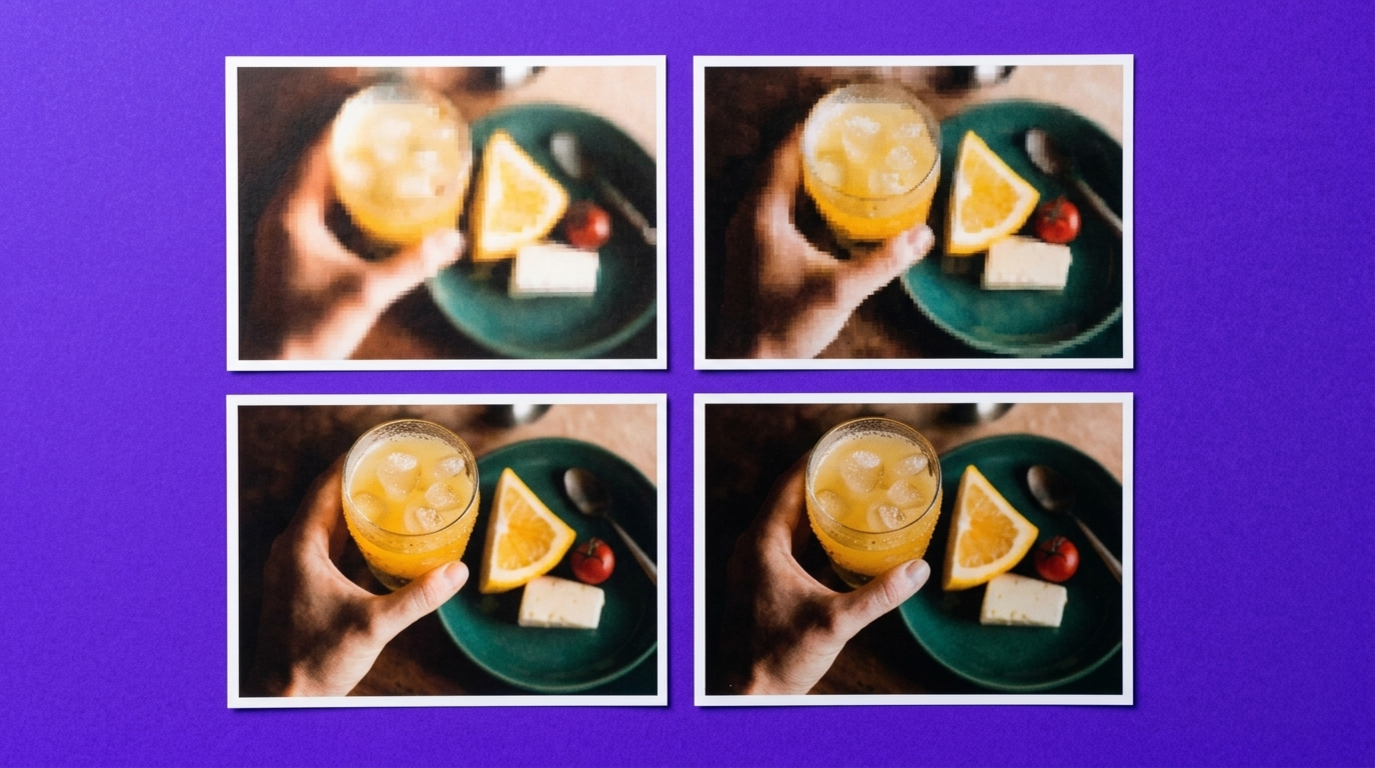
This comparison covers seven tools that designers actually use, including prices, file limits, and the specific cases where each one falls short.
No tool is perfect for every job, so the info below is designed to help you choose the right one for yours.
What to look for in an AI image upscaler
Before the comparisons: the right tool depends on what you're upscaling and what happens afterward.
Output resolution. Most tools cap free upscaling at 2X or 4X. For print work, you often need 4X or higher to hit the required DPI. Check the cap before you commit.
File format support. JPEG and PNG are universal. If your workflow involves WEBP, HEIC, or SVG, verify the tool handles them.
Quality vs. creativity. "Crisp" upscaling adds pixels without modifying the image. "Creative" or "generative" upscaling uses AI to fill in detail, which improves low-res faces and textures but can alter the image. Know which mode you're running.
What comes next. If you're going back into a design tool after upscaling, you want clean exports and ideally a vectorization option. If you're publishing directly, format and compression matter more.
In-depth comparison: Exploring 5 of the best AI image upscalers
1. Recraft
Best for: Designers who need upscaling inside a complete creative workflow.
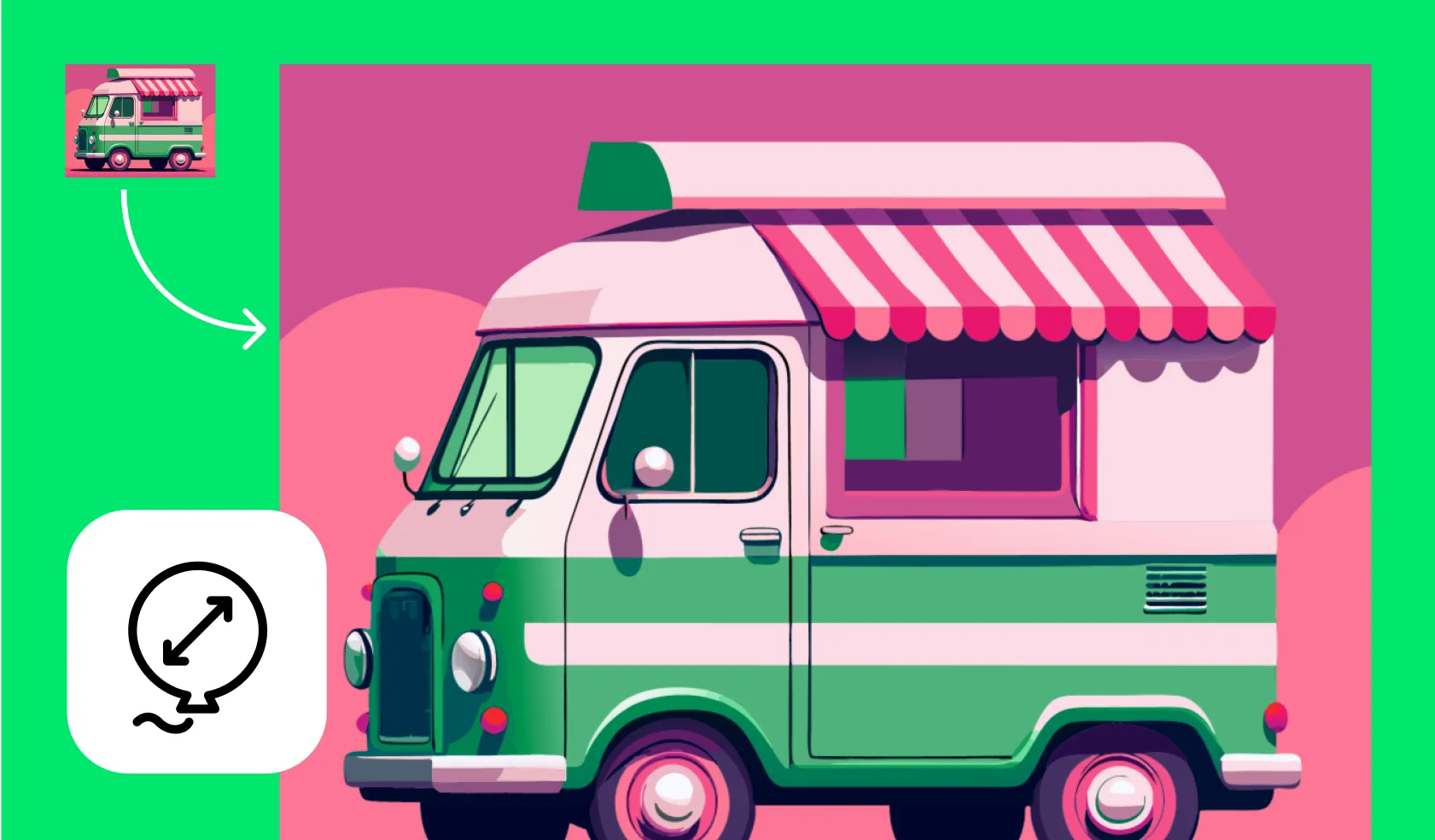
Recraft's image upscaler offers two modes: Crisp Upscale (1 credit) increases resolution without modifying the image, ideal for clean assets up to 4 Mpx. Creative Upscale (20 credits) runs a generative pass that improves detail and sharpens faces, suited to source images between 256 px and 16 Mpx.
The upscaler sits inside Recraft Studio alongside an AI image generator, a background remover, an SVG vectorizer, and an AI eraser. That matters for designers who regularly move between generation, editing, and export without switching tools. Recraft V4.1 also supports custom DPI and CMYK output, which standalone upscalers generally don't.
Pricing. The free tier gives 30 daily credits. Paid plans start at $12.50/month (Basic, 1,000 credits/month) and go up to $22.50/month for Teams.
Honest limits. Crisp Upscale is constrained to 4 Mpx source images. Creative Upscale takes longer and can alter textures. Neither mode competes with Topaz Gigapixel on raw resolution ceiling for large-format print.
Best for: Maximum resolution output, especially for large-format print.
Topaz Gigapixel AI is the benchmark for pure upscale quality. It runs locally on Mac or Windows, processes images up to 6X, and has specialized models for faces, fine detail, and compression artifact removal. For photographers and print designers who regularly need to deliver at very high resolution, it's the most reliable option available.
Pricing. Topaz moved to subscription-only in September 2025. Gigapixel as a standalone app costs around $50/month or roughly $19/month on an annual plan. The full Topaz Studio suite (all desktop and cloud apps) is $69/month or $45/month annually. No free tier beyond the trial.
Honest limits. Desktop-only, no browser version. The end of the one-time license in 2025 made the value calculus significantly worse for occasional users. If you upscale a few images a month, the math doesn't work. No creative tools beyond upscaling.
3. Magnific AI
Best for: Generative upscaling where creative detail enhancement is the goal.
Magnific uses a different approach: rather than predicting missing pixels, it generates plausible detail based on a text prompt and the source image. This produces sharp, high-detail results that can look substantially better than source-faithful upscaling for stylized work, faces, and textures. The tradeoff is that the output is a creative interpretation, not a faithful enlargement.
Pricing. Plans start at $20/month (2026 pricing, after a July 2026 restructure added lower-entry tiers). The Pro plan sits at $39/month with roughly 200 normal upscales. No free tier. Credits expire at month-end with no rollover, so subscribe only when you have active work to process.
Honest limits. Not appropriate when you need pixel-accurate fidelity. Credits do not roll over. At high creativity settings, the model invents detail that wasn't in the source, which is a feature for editorial work and a liability for anything requiring faithfulness to the original.
3. Magnific AI
Best for: Generative upscaling where creative detail enhancement is the goal.
Magnific uses a different approach: rather than predicting missing pixels, it generates plausible detail based on a text prompt and the source image. This produces sharp, high-detail results that can look substantially better than source-faithful upscaling for stylized work, faces, and textures. The tradeoff is that the output is a creative interpretation, not a faithful enlargement.
Pricing. From $39/month. No meaningful free tier.
Honest limits. Expensive relative to other options. Not appropriate when you need pixel-accurate fidelity. No batch processing.
4. Let's Enhance
Best for: Online upscaling without installing anything.
Let's Enhance is a browser-based tool that supports upscaling up to 16X and handles most common formats. Five free images is enough to test whether the quality meets your needs. Batch processing is available on paid plans, making it a workable option for processing multiple assets quickly without a desktop app.
Pricing. Five images free. Paid plans from $12/month.
Honest limits. Free tier is limited. Results at the high end (8X–16X) can introduce artifacts, particularly on textured sources.4. Let's Enhance
Best for: Online upscaling without installing anything.
Let's Enhance is a browser-based tool that supports upscaling up to 16X and handles most common formats. The free tier gives 10 credits (with a watermark applied), which is enough to test quality before committing. Batch processing is available on paid plans, making it a workable option for processing multiple assets quickly without a desktop app.
Pricing. 10 free credits with watermark. Paid plans from $9/month (billed annually) or $12/month monthly for 100 credits. Unused credits roll over on paid plans.
Honest limits. Free tier is limited. Results at the high end (8X–16X) can introduce artifacts, particularly on textured sources.
5. Upscayl
Best for: Free, offline, local upscaling with no usage limits.
Upscayl is an open-source desktop app for Mac, Windows, and Linux that uses ESRGAN models to upscale images locally. No account, no credits, no upload limits. It supports batch processing and produces solid results for line art, illustrations, and screenshots. Because everything runs on your machine, it works without an internet connection and processes files of any size given sufficient GPU memory.
Pricing. Free and open source.
Honest limits. Requires a GPU for reasonable processing speed. Less accurate on faces and complex textures than Topaz Gigapixel or Magnific. The UI is functional, not polished.
6. Krea AI
Best for: Real-time upscaling in a generative creative workflow.
Krea's enhancer runs real-time upscaling with an adjustable strength dial that lets you control how much creative detail the model adds. It bundles seven upscaling models including Topaz Photo and Topaz Gigapixel, and the Max plan supports output up to 22K resolution. It's best suited to designers already using Krea for image generation who want upscaling in the same environment.
Pricing. The free plan gives 100 compute units per day with no credit card required, which includes basic upscaling up to 2K. Paid plans run from $9/month (Basic) to $35/month (Pro) to $70/month (Max). The full creative enhancer with the strength dial requires a paid plan.
Honest limits. Not the right call if upscaling is your only need. Compute units are consumed differently by different models, making it hard to predict exactly how many upscales your monthly allocation covers.
7. Upscale.media
Best for: High-volume online upscaling at low cost.
Upscale.media (a PixelBin product) supports PNG, JPG, JPEG, WEBP, and HEIC files and offers 2X, 4X, 6X, and 8X options. The free tier is very limited at 3 credits, but the paid plans are priced for volume users who need to process batches of images regularly.
Pricing. 3 free credits. Paid plans from roughly $5/month.
Honest limits. Free tier is too limited for most workflows. Ads on the free version. The UI toggle that zooms into upscaled areas on hover is a useful quality check.
How to choose
If you're a designer who needs upscaling as one step in a broader workflow, Recraft is the practical default. The free tier is generous, V4.1 covers generation through export, and you don't need a separate tool for background removal or vectorization.
If print quality is your main concern and you're upscaling large source files regularly, Topaz Gigapixel is worth the one-time cost.
If you're doing creative or editorial work where generative detail enhancement is the point, Magnific is the stronger choice.
If you want no cost and no usage limits and you have a capable GPU, Upscayl is the obvious answer.
An AI image upscaler increases the resolution of a photo or graphic while preserving detail. Instead of stretching pixels, it uses machine learning to reconstruct texture, sharpen edges, and clean up compression artifacts — so the larger version still looks crisp on a hero banner, product shot, or print layout.
Can I use upscaled images for print and commercial work?
Yes, on paid plans. Free accounts include up to 30 generations and edits per day with non-commercial use; paid plans add commercial rights and higher daily limits. Details on Recraft pricing.
How much can I upscale an image?
Recraft upscales up to 4K while keeping the image sharp. For a typical web photo, that means going from ~1000px to 4000px on the long edge — enough for a print-ready file or a high-resolution hero.
What file formats does the upscaler support?
Drag and drop a JPG, PNG, or WebP. The upscaled file lands in Recraft Studio, where you can export as PNG, JPG, TIFF, or PDF — or keep editing on the same canvas.
Does upscaling improve photo quality or just enlarge the image?
It improves quality. A simple resize stretches existing pixels and softens detail. Recraft’s AI image enhancer recovers texture, sharpens edges, and cleans up compression artifacts as it scales — so the larger output is usable for production, not just bigger.
.svg)